


Design approach 1: Speculative design
- lfei557
- Aug 5, 2022
- 4 min read
Updated: Aug 27, 2022
Speculative design
What are the key features of Speculative design?
The speculative design was initially coined in the 1990s, and sometimes it is called critical design or design fiction. It is used to solve big social problems and look into the future. Also, to create products and services for those scenarios. Anthony Dunne pioneered this work with Fiona Raby, who developed it as part of their Design Interaction project at the Royal College of Art. Their students and others worldwide look at the future differently through various disciplines and lenses. For example, the construction industry anticipates new materials, changing landscapes, and future technologies. Anthony Dunne and Fiona Raby popularized the idea in their book, Speculative Everything: Design, Dreaming, and Social Dreaming. They believe that speculative design allows designers to use their imagination to develop new ground-breaking systems and prototypes for future societies.

Figure 1: Designers at a Speculative Futures workshop discuss the future of food in 2026
A key feature of Speculative Design requires designers to go beyond user-centered design and ask what impact our designs might have on society in the future. Dunne and Ruby stated that those who try to predict the future are often wrong. Instead, the speculative design aims to imagine all the possible futures that could be. Therefore, the book presents a taxonomy of possible futures.
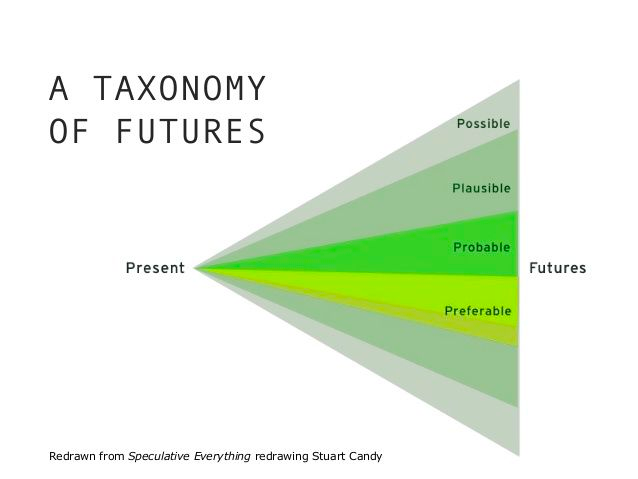
Figure 2: A taxonomy of possible futures in Speculative Everything (Dunne and Raby, 2013)
How does it differ from the design frameworks you’ve encountered on the Design programme so far?
The key feature of speculative design is that it does not use tools, methods, and processes like other frameworks to find solutions but continues to explore problems. Even designers can use a speculative approach to explore the values they practice.

Figure 3: Traditional design vs. speculative design in Introduction to Speculative Design Practice (2015)
Mitrović (2015) states that this approach to design does not focus on meeting current and future consumer needs but on rethinking a technological future that reflects the complexity of today's world. In simple terms, the traditional approach to design is to solve an existing problem or optimize an existing solution.

Figure 4: Double diamond design framework
A good example is double diamond frameworks. It creates customer-focused solutions through iteration. However, I’ve encountered that we can do little to create radical solutions to big problems such as global warming, poverty, gender inequality, etc. There is no one-size-fits-all solution. Speculative designers see user-centredness as highly problematic compared to designers using traditional design methods (Neeley, n.d.). Once the design is focused on the narrow needs of the user, it gives us a limited view of the opportunity space we are working in. It is why we need the speculative design to solve 'big' issues.
Beyond Speculative Design
What are the strengths of this mode of design?
With the rapid development of technology, some companies are beginning to expect to follow the advancement of technology. To better adapt to technological development, constantly being on the path of innovation can help companies occupy the future market. Therefore, speculative design is an excellent tool for combining a future vision with design practice. A good example is Earth 2050, which will discuss in detail in the case study below. In other words, the speculative design provides a space for discussing the potential of future scenarios.
Generally speaking, design is now more of a commercialized money-making tool to meet the client's needs to get things done (Tran, 2019). Conversely, the speculative design allows designers to do creative design. And to think about what impact our plans might have on society in the future during the design process.
What are the limitations of this mode of design?
However, we cannot ignore the limitations of speculative design. One of the main ones is that we cannot get a solution to a problem in a short period. As a result, some companies and governments consider solutions such as this to potential future issues to be futile. We cannot accurately predict the future, but when a problem arises, it becomes a problem that cannot be solved "in the present." But now, as more and more success stories emerge, some companies are using speculative design as a forerunner to get ahead of the market.
Case study
Earth 2050

Figure 5: what Mumbai might look like in 2050 (Earth 2050)
Earth 2050 was designed by Kaspersky in 2021. It’s a site about the future by uses the idea of speculative design. Kaspersky created the website with some futurologists, scientists, and Internet users from all over the world. The users can select a year from 2030,2040, and 2050 to view and study the predictions for different cities and countries. It provides a platform for people to imagine what will happen to the earth, what people's lives will be like, what jobs people will do, what food people will eat, and so on. The goal for Kaspersky is to make the world a safer place through this project. To prepare for the future, we need to have a mental picture of the future life.

Figure 6: Earth 2050 Red Dot Design Award
The Earth 2050 website allows users to vote, comment, and make predictions about the future life. It is a more successful example of speculative design than the other cases my group analyzed. Because in this project, people can use all the conclusions to suggest what needs to be protected, what threats will exist, and how the physical and virtual worlds will interact. So that people can prepare for the challenges ahead.
References:
Dot, R. (2022, August 15). Red dot design award: Earth 2050. Red Dot Design Award. https://www.red-dot.org/project/earth-2050-16419-16416
Earth 2050 (n.d.). Earth 2050: A glimpse into the future | Kaspersky. https://2050.earth/
Mitrović, I. (2015), Introduction to Speculative Design Practice, Speculative.Hr, http://speculative.hr/en/introduction-to-speculative-design-practice/
Speculative everything: Design, fiction, and social dreaming. (2013). MIT Press.
Tran, T. H. (2019, April 8). Speculative design: 3 examples of design fiction | Inside design blog. Collaborate better | InVision. https://www.invisionapp.com/inside-design/speculative-design/


Comments